

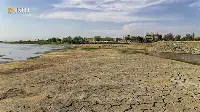
The wheat fields outside Seqalbia, near the Syrian city of Hama, should be golden and heavy with grain.
Instead, Maher Haddad’s 40 dunums (10 acres) are dry and empty, barely yielding a third of their usual harvest.
“This year was disastrous due to drought,” said the 46-year-old farmer, reflecting on the land that cost him more to sow than it gave back.
His fields delivered only 190kg (418 lbs) of wheat per dunum – far below the 400-500kg he relies on in a normal year.
“We haven’t recovered what we spent on agriculture; we’ve lost money. I can’t finance next year and I can’t cover the cost of food and drink,” Mr Haddad told the BBC.
With two teenage daughters to feed, he is now borrowing money from relatives to survive.
Mr Haddad’s struggle is echoed across Syria, where the worst drought in 36 years has slashed wheat harvests by 40% and is pushing a country – where nearly 90% of the population already lives in poverty – to the brink of a wider food crisis.
A report from the United Nations’ Food and Agriculture Organization (FAO) estimates Syria will face a wheat shortfall of 2.73m tonnes this year, the equivalent of annual dietary needs for 16.25 million people.
Without more food aid or the ability to import wheat, Syria’s hunger crisis is set to worsen dramatically, warned Piro Tomaso Perri, FAO’s senior programme officer for Syria.
“Food insecurity could reach unprecedented levels by late 2025 into mid-2026,” he said, noting that more than 14 million Syrians – six in 10 people – are already struggling to eat enough. Of those, 9.1 million face acute hunger, including 1.3 million in severe conditions, while 5.5 million risk sliding into crisis without urgent intervention.
The same report showed rainfall has dropped by nearly 70%, crippling 75% of Syria’s rain-fed farmland.
Discover more from Keeping Them Honest
Subscribe to get the latest posts sent to your email.