

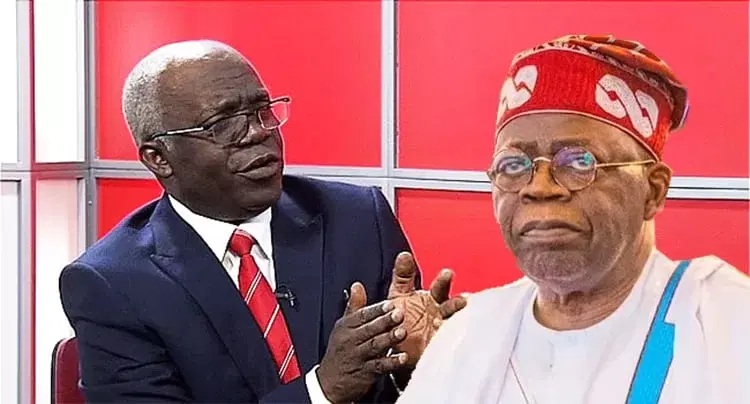
…Nigerians Can’t Afford Food and Medicine, Says Utomi
…Fund NSIP With N5Trillion Now- Falana
Professor of Political Economy, Pat Utomi, has criticised President Bola Tinubu’s economic policies, warning that the administration’s aggressive focus on revenue generation is damaging the economy and worsening the suffering of ordinary Nigerians.
Speaking during a television interview, Utomi decried the government’s obsession with boosting revenues at all costs, arguing that this approach is suffocating productive sectors of the economy, especially agriculture and small businesses. He noted that instead of channeling resources to stimulate food production and agricultural value chains, the government continues to divert funds towards non-productive sectors like the political class.
Utomi pointed to skyrocketing port charges as an example of how the administration’s revenue drive is pushing traders and importers out of business. According to him, the cost of clearing a container at Nigerian ports has become prohibitively expensive, with rates soaring to about N18 million per container. This, he warned, is particularly devastating for pharmaceutical importers, whose already-thin profit margins on essential drugs like anti-malarials are being wiped out by these excessive levies.
He lamented that while government revenues appear to be rising, these gains are being squandered by politicians, with little or no positive impact on the lives of ordinary Nigerians. Utomi stressed that using revenue figures as proof of economic progress reflects a fundamental misunderstanding of economics. He insisted that genuine growth can only be measured by job creation, improved living standards, and the affordability of basic goods.
Utomi dismissed recent claims of economic recovery, arguing that marginal improvements in the naira or GDP figures mean nothing if inflation continues to erode the purchasing power of Nigerians. He cautioned that a nation cannot claim to be progressing when its people are unable to afford food, healthcare, and other essentials. For any meaningful change to occur, he said, the government must urgently redirect its focus to investments in agriculture, education, and healthcare.
Echoing these concerns, Human Rights Lawyer and Senior Advocate of Nigeria (SAN), Femi Falana, urged President Tinubu to stop passing the responsibility of poverty alleviation to state governors and instead take direct leadership in addressing the crisis.
Falana was reacting to Tinubu’s recent meeting with All Progressives Congress (APC) governors, where the president acknowledged the harsh economic realities at the grassroots and appealed to state leaders to “wet the grass” by delivering more progressive policies. Falana, however, argued that such appeals are insufficient, and that the Federal Government must lead from the front by fully funding existing social welfare programmes.
He noted that the National Social Investment Programme (NSIP), designed to reduce poverty through initiatives like N-Power, school feeding, soft loans, and conditional cash transfers, remains grossly underfunded. Falana criticised the allocation of N32.7 billion to NSIP in the 2025 budget, contrasting it sharply with the N39 billion reportedly spent on renovating the International Conference Centre in Abuja.
According to Falana, it is indefensible for a government to allocate more funds to infrastructure upgrades than to social safety nets intended to support the country’s 133 million multidimensionally poor citizens. He stressed that the resources to fund these programmes adequately already exist, citing the N11.195 trillion disbursed to states, local governments, and the FCT over the past year through the Federation Accounts Allocation Committee (FAAC).
Falana also referenced a BudgIT report which exposed how the National Assembly allegedly padded the 2025 federal budget with over 11,000 constituency projects worth nearly N7 trillion, accounting for about 12.5% of the N54.99 trillion budget signed into law by President Tinubu. He questioned how lawmakers could justify such extravagance, with senators reportedly earning N21 million monthly and House members N15 million, while critical social programmes remain starved of funds.
While acknowledging the Federal Executive Council’s recent approval of N3.5 trillion for roads, airports, and other infrastructure, Falana demanded a similar sense of urgency towards the social sector. He called for the immediate approval of not less than N5 trillion to fund the NSIP, warning that anything less would amount to lip service in the fight against poverty.
To ensure transparency and effectiveness, Falana recommended that the management of these funds should not be left solely to government officials but should include credible representatives from trade unions and civil society organisations.
Both Utomi and Falana warned that the continued neglect of social welfare, alongside the government’s fixation on revenue targets, could worsen public frustration and further erode confidence in the administration.
Discover more from Keeping Them Honest
Subscribe to get the latest posts sent to your email.