

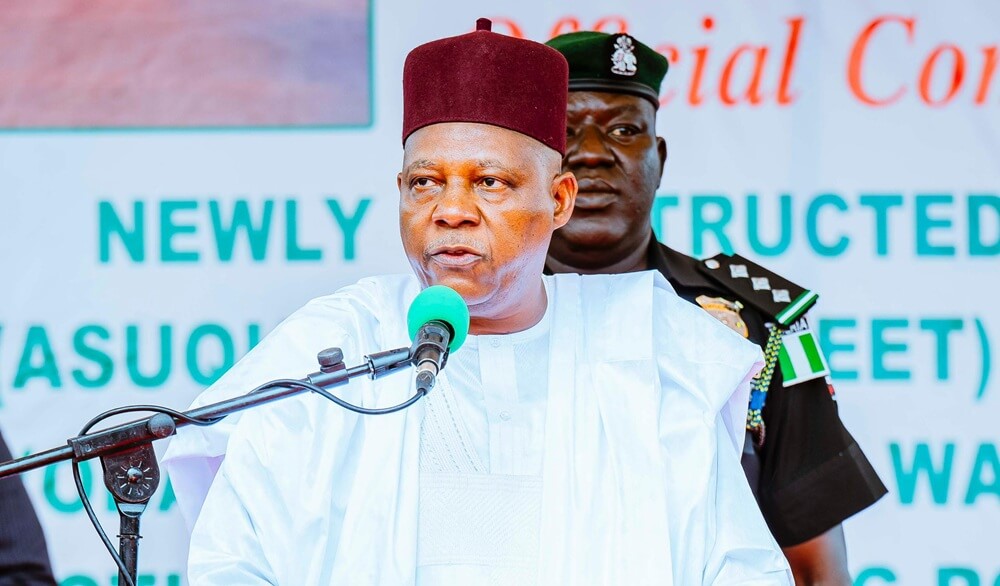
Vice-President Kashim Shettima said Nigeria is deploying Artificial Intelligence (AI) and other modern technologies to monitor food production, enhance transparency, connect producers to markets, and reduce waste across the agricultural value chain.
Shettima said this at the opening Session of the United Nations Food Systems Summit Stocktake (UNFSS+4), in Addis Ababa, yesterday.
The summit will build on the momentum of the 2021 UN Food Systems Summit and the first Stocktake in 2023 (UNFSS+2), focusing on accelerating sustainable, inclusive, and resilient food systems transformation.
The event will spotlight successful country-level transformations, highlight innovative practices, and address challenges faced in fragile and conflict-affected settings.
The vice-president said that food and nutrition were now central pillars of both the National Development Plan 2021 to 2025 and the Nigeria Agenda 2050.
He stated that food insecurity was no longer a shadow lurking in distant lands, adding, “it is a shared affliction, whether you live by the banks of the Niger or the banks of the Tiber, you will find the same truth.
Shettima said, “The Fourth Industrial Revolution has not only disrupted the old order but gifted us instruments that were once confined to the imagination.
“Artificial intelligence, geospatial analytics, and satellite-driven climate intelligence are now part of our agricultural vocabulary.
“We are deploying these tools to monitor production, enhance transparency, connect producers to markets, and reduce waste across the value chain.
“Our faith in the capacity of our people remains unshaken. In partnership with the African Development Bank and IFAD, we are investing in Special Agro-Industrial Processing Zones.
“These hubs are not just places of production. They are engines of transformation.”
He said that they were creating jobs, attracting private capital, and linking rural producers to national and global markets.
The vice-president added,” But production is not enough. We believe that a sustainable food system must also be a healthy one.”
Shettima said that Nigeria had scaled up investments in school feeding programmes, nutrition-sensitive agriculture, and community-driven nutrition education.
According to him, through the Nutrition 774 initiative, the government is placing all of Nigeria’s 774 local governments at the centre of nutrition delivery.
Shettima disclosed that the Federal Executive Council (FEC) had approved the National Multi-Sectoral Plan of Action for Food and Nutrition to serve as the implementation arm of revised national food and nutrition policy.
He added that government had directed the establishment of Nutrition Departments in relevant Ministries.
According to him, these are the building blocks of institutional reform and the architecture of nutrition governance.
Discover more from Keeping Them Honest
Subscribe to get the latest posts sent to your email.