

By Peter Salami
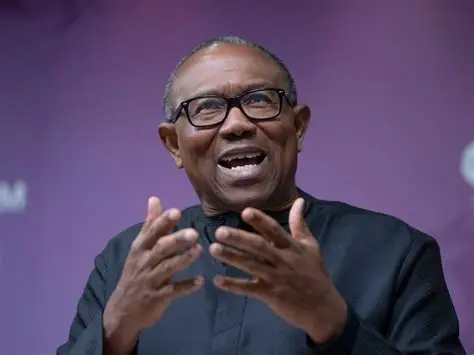
Labour Party’s 2023 presidential candidate, Mr. Peter Obi, has declared that four years is sufficient for any serious-minded leader to begin rebuilding Nigeria, if the will and sincerity of purpose are present. In a statement that is likely to shape conversations ahead of the 2027 elections, Obi said he does not need more than a single term to prove that good governance is possible.
The proposal, submitted last week to the emerging opposition coalition, is already generating momentum among political stakeholders. Dr. Yunusa Tanko, National Coordinator of the Obidient Movement Worldwide, confirmed Obi’s submission and expressed confidence in its merit. The plan is being considered as a blueprint for an opposition realignment aiming to unseat the Tinubu administration in 2027.
In a statement issued by his media aide, Ibrahim Umar, Obi stressed that his call for a four-year presidency is rooted in the need to respect Nigeria’s informal zoning arrangement — a political practice he said has kept the country’s fragile unity intact, even though it has no constitutional basis.
“One term is enough to establish that good governance is possible,” Obi said. “If bad governance can ruin a country in two years, why should it take forever to begin fixing it? Nigerians want to wake up and see a leader who shows compassion, competence, and direction. That’s all.”
He emphasised that he does not seek personal gain or longevity in power. “I don’t need a day more than four years. I will show the direction of good governance. Even two years is enough to turn things around for the better,” he added.
On the growing speculation that he may team up with former Vice President Atiku Abubakar as a running mate, Obi firmly rejected the idea: “This is not in play. Nobody has ever discussed that with me. People make all sorts of assumptions, but there is no such conversation.”
He also responded to criticisms surrounding his open support for the opposition coalition, which has adopted the African Democratic Congress (ADC) as its new political platform. While critics have accused the coalition of harbouring politicians from failed past governments, Obi argued that experience — including from those who once failed — is critical for avoiding similar mistakes.
“Even in the corporate world, companies hire people from failed organisations because they understand what went wrong. You need both scars and successes. The experience of failure is valuable, and we must learn from it,” he said.
In a parallel development, the ADC has dismissed suggestions that it compromised its standards to accommodate high-profile defectors. Speaking on The Morning Brief on Channels TV, Chairman of the ADC Board of Trustees, Ibrahim Mani, said the party remains guided by constitutional standards and a commitment to inclusivity, not opportunism.
“A political party is an all-comers affair, but within legal and ethical limits. Anyone who hasn’t been convicted by a competent court and meets the age and nationality requirements is welcome,” Mani said.
The ADC, recently overhauled to serve as the primary opposition platform in 2027, has undergone a full leadership reset. Former Senate President David Mark now serves as interim chairman, with ex-Osun Governor Rauf Aregbesola as secretary and former Minister Bolaji Abdullahi as publicity secretary.
Mani acknowledged criticisms but maintained that the party is focused on building a credible alternative. “The idea isn’t to create a dumping ground. It’s to form a serious coalition that will challenge the status quo and offer Nigerians a new direction.”
According to him, the party has witnessed a massive influx of members — so large that its website had to be re-hosted three times in one week due to repeated crashes caused by registration traffic. “There’s a groundswell of support. Nigerians are searching for something new — and they believe they’ve found it in the ADC,” he said.
Mani added that while the new structure is still evolving, the groundwork is being laid for a truly national party built from the grassroots. “We’re not just importing politicians. We’re building a new structure, bottom-up. Nigerians want change, and we are responding to that call,” he said.
His remarks come as concern grows over the weakening of opposition forces and the risk of Nigeria slipping into a one-party state. Analysts have warned that without a strong alternative to the ruling APC, democratic accountability and governance may continue to suffer.
With Peter Obi’s single-term offer on the table, and the ADC positioning itself as the new face of the opposition, a reshaped political front appears to be taking form ahead of 2027.
Discover more from Keeping Them Honest
Subscribe to get the latest posts sent to your email.