

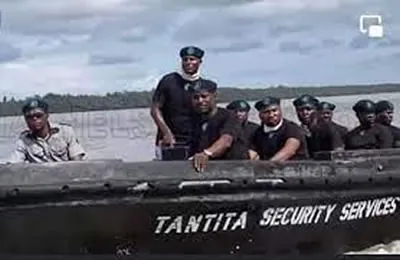
The controversy surrounding the renewed $144 million pipeline surveillance contract awarded to Tantita Security Services Nigeria Limited, owned by ex-militant leader Government Ekpemupolo, popularly known as Tompolo, is threatening to escalate into a full-blown crisis. What began as a strategic security initiative is now being exposed for what it appears to be: a dangerously opaque, exclusionary, and potentially destabilizing arrangement that threatens the very peace it claims to preserve.
At the heart of the matter is the Federal Government’s decision to place the surveillance of critical oil infrastructure in the Niger Delta region in the hands of private firms closely tied to a single former warlord, and one or two others. This move has triggered outrage from other former militant leaders, indigenous communities, and cultural institutions across the Delta. They are not merely objecting to being left out of the economic pie. They are raising alarms about human rights violations, unaccountable private militias, and creeping militarization of their ancestral lands.
Asari Dokubo, former militant and monarch of Torusarama Piri (Elem Kalabari), did not mince words when he accused Tompolo of cornering a contract that was originally meant to be distributed among multiple ex-agitators under the Jonathan administration. In an emotional rebuke, Dokubo alleged that for years, Tompolo received $144 million annually but failed to include or consult others, despite presidential assurances that the contract was meant for all. This, he claims, is a betrayal not only of personal trust but of the spirit of the Niger Delta amnesty and reintegration framework.
More troubling still are the claims coming from communities directly affected by Tantita’s operations. The Urhobo Progress Union (UPU), the foremost socio-cultural group of the Urhobo people, has demanded Tantita’s removal from Urhobo territories, citing alleged human rights abuses, intimidation, and lack of accountability. Urhobo youths have taken to the streets in protest. Anonymous voices from these communities speak of brutality, threats, and private detention centres, raising deeply troubling questions about how far this company has been allowed to operate outside the boundaries of lawful conduct.
As we speak, a formal petition has been submitted to President Bola Ahmed Tinubu by the Itsekiri Public Affairs Commission (IPAC), led by Oritsegbubemi Adrian Edema. Titled “Tantita Security Services Nigeria Limited as a Tool of Terror, Occupation, and Annexation of Itsekiri Homeland”, the document lays out a chilling picture of Tantita operatives invading, occupying, and militarizing Itsekiri communities—including Aja-Ugbodundun, Uso, Akpata, and Sahara in the Ugborodo axis. The petition alleges the existence of a private Tantita cell in Opuraja, where detainees are reportedly held and tortured. These are not idle accusations; they demand urgent, impartial investigation.
The list of demands from the Itsekiri people is long, but it is also reasonable: withdraw Tantita from occupied communities, disarm the operatives, investigate human rights violations, and provide state protection for indigenous groups. These are not acts of rebellion. They are acts of resistance against what appears to be a creeping state-sanctioned occupation under the guise of pipeline protection.
Worse still is the air of impunity surrounding this contract. Since the renewal by the Nigerian National Petroleum Company Limited (NNPCL) in 2024, there has been a disturbing lack of transparency about its terms, performance metrics, oversight mechanisms, or exit clauses. The recent shake-up at the top of NNPCL—with President Tinubu replacing Mele Kyari—offers a critical opportunity to review not just the personalities involved but the entire framework of privatized pipeline protection.
This newspaper understands the rationale behind involving ex-militant leaders in protecting oil infrastructure. After all, they know the terrain, the players, and the bad guys. But any such arrangement must be inclusive, accountable, time-bound, and subject to democratic oversight. It must not create a paramilitary Frankenstein with de facto control over vast swathes of the Niger Delta.
The federal government must recognize the gravity of what is at stake. The Niger Delta remains one of the most volatile, economically significant, and environmentally fragile regions in Nigeria. Allowing one man, no matter his “paramilitary” credentials or political connections, to dominate its security architecture is a recipe for renewed militancy, community resistance, and a violent breakdown in law and order.
It is also politically dangerous. Already, the Olu of Warri has been drawn into the fray, with reports suggesting that he has interests in another surveillance contract covering not just the Ilaje and Itsekiri axis, but areas of Rivers State. This has introduced a new ethnic dimension to the controversy. When pipeline protection contracts become ethnic flashpoints, we are no longer talking about mere economic inclusion; we are dealing with the seeds of future conflict.
To be clear: this is not about Tompolo the individual. It is about statecraft. It is about the integrity of public procurement, the rights of indigenous peoples, and the government’s constitutional duty to ensure that no citizen or company operates above the law. It is about preventing the emergence of a parallel security structure that answers not to the Nigerian people, but to itself, and the narrow band of private interests it represents.
President Tinubu, who campaigned on a platform of renewed hope and rule of law, must act decisively. He must order an independent investigation into the operations of Tantita Security Services. He must meet with all stakeholders: ex-militant leaders, traditional rulers, civil society groups, and affected communities, to chart a new, inclusive, and constitutionally sound approach to pipeline protection. He must signal that this administration is not in the business of licensing private armies or rewarding impunity.
Let this be a turning point. Let it not be said that under this democratic dispensation, we watched a single company morph into a quasi-state actor in one of the most delicate regions of the country.
Tantita’s contract must not be renewed without a full and transparent review. Anything less would be a betrayal of public trust, and an invitation to chaos.
Discover more from Keeping Them Honest
Subscribe to get the latest posts sent to your email.