

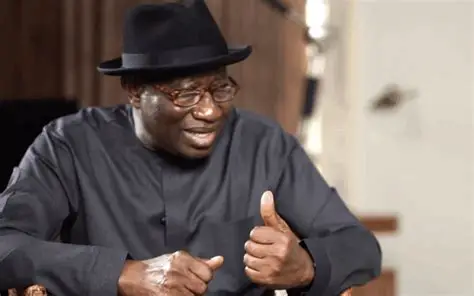
. Urges Nigerian youths to choose leaders base on competence, not tribe, religion
By Jeremy Fregene
In a startling revelation, former President, Goodluck Jonathan has disclosed that a top presidential aide deliberately withheld a handover letter written to the National Assembly by the late President, Umaru Musa Yar’Adua during his prolonged illness.
He disclosed this in an interview on Talking Books African, a programme by the Rainbow Book Club.
Jonathan disclosed that Yar’Adua had written a formal letter to empower him as acting president before travelling abroad for medical treatment in 2010, but the aide entrusted with the document refused to submit it to lawmakers.
The former president said the aide’s action plunged the country into a constitutional crisis, leaving Nigeria without an acting president or commander-in-chief for months.
He explained that while he could perform executive functions as Vice President, including presiding over Federal Executive Council (FEC) meetings and approving ministerial memos, he lacked the constitutional authority to act as commander-in-chief without the formal letter.
He noted that the crisis forced the National Assembly to invoke the “doctrine of necessity,” empowering him to act as president without an official letter, a move he compared to the swift transition protocols in the United States of America (USA).
Jonathan said: “There’s always a balancing between North and South, Muslims and Christians. Yar’Adua was a Northern Muslim, serving as president. He took over from a Southern Christian, Obasanjo, who ruled for eight years.
“Definitely the Northern Muslims wanted Yar’Adua to at least do eight years before power would return to the South, likely to another Christian. But his health issues came up, and it was a problem. That’s why even allowing me to act as president became an issue.
“One year that Yar’Adua was going for a medical checkup. Actually, a letter was written. Of course, the constitution says that for the vice president to act, the president would send a letter to the Senate and the House of Representatives informing them.
“That letter was written, but the person to whom the letter was handed over, I will not mention the name to you now, was one of the aides of Yar’Adua, and refused to submit the letter to the National Assembly. And Yar’Adua became so ill that he had no control over issues.
“So, we had a country where the president was not available, and there was no acting president. Yes, as a vice president, you can take over the responsibilities of some of the responsibilities of president. You know the president of Nigeria has two main responsibilities.
“First, you are the chief executive of the country, so, like a prime minister of a country. That, the vice president can assume, you don’t need any transfer. And I was doing that because we were having an executive council meeting; we were approving memos from ministers, so the government was going on.
“But there was no commander-in-chief. What is the second responsibility of the president of Nigeria, besides being the executive head of the country? And there’s nothing like acting commander-in-chief. Either you’re a commander-in-chief or not.
“But when you become an acting president, you are at the same time a commander-in-chief. So that was lacking, and no country allows that gap. A country like America doesn’t allow that gap at all.
“If an American president wants to, even if it’s a whitlow, that he requires an extension, that he will be off for five minutes, he will hand it over to the vice president before that procedure. Immediately he regains consciousness, he takes over. But we stayed for some time.
“And that led to what they call the doctrine of necessity. When the National Assembly felt that the country was in a situation that was not expected, they had to initiate the doctrine of necessity. And they now made me act as a president without a letter from Yar’Adua.”
After Yar’Adua died in May 2010, Jonathan completed his term before winning the 2011 presidential election.
Meanwhile, Jonathan has asked young Nigerians to prioritise competence over religion and tribe in choosing leaders.
The former president said Nigeria’s deepening divisions along tribal and religious lines remain one of the biggest obstacles to national development.
The former president said that tribe and religion are a major setback to the country’s leadership recruitment process.
“Nigeria today — we are divided along tribal and religious lines, and it worries me. And if we don’t make any changes, which are difficult to make, it may continue to our grandchildren because we started wrongly. There is no effort to make sure we change, and it is a major problem. Most of the problems we have today in the country are because of this division,” he said.
“Young people should know that the issue of tribe and religion is a major setback for this country. It creates problems with leadership recruitment. If somebody is holding a political office and wants to make an appointment, he begins to see that even if Mrs A knows the issue better than Mrs B, and Mrs B is from his tribe, he wants to use Mrs B.
“That is what happens in a system where we tend towards tribes, and that is one of the banes of Nigerian politics. The leadership recruitment process is skewed along tribal and religious interests. So, you see how difficult it is to get the best.
“There are some states where if you come from some parts of the state, you cannot be governor, even if you are the best material at the time. In Nigeria, if you want to contest an election, they first ask: ‘Is it our turn? Is it their turn? Is it the turn of the Muslims? Is it the turn of the Christians? This creates a problem in recruiting the best material,” Jonathan explained.
The former Nigerian leader, also revealed that at a point in the life of his administration, he was advised to leave the Presidential Villa during President Umaru Yar’Adua’s health crisis over fears of a potential military coup.
He recalled that some associates urged him to sleep elsewhere for safety, warning that the North-South and Christian-Muslim divide had created a volatile atmosphere.
“Every day I was hearing about a coup. Some friends said, ‘Don’t sleep in the Villa, come stay at my guest house,’” he recounted.
“But I refused. If they wanted to kill me, let it be in the State House so Nigerians would know I was assassinated there. I had committed no offence.”
Jonathan’s account underscores the tense power dynamics and personal risks he faced during one of Nigeria’s most delicate transitions of power.
Discover more from Keeping Them Honest
Subscribe to get the latest posts sent to your email.