

..Keyamo, Sani Clash Over Coat-Of-Arms, Timing
..Makinde, George: It’s Of No Consequence
By Yinka Giwa
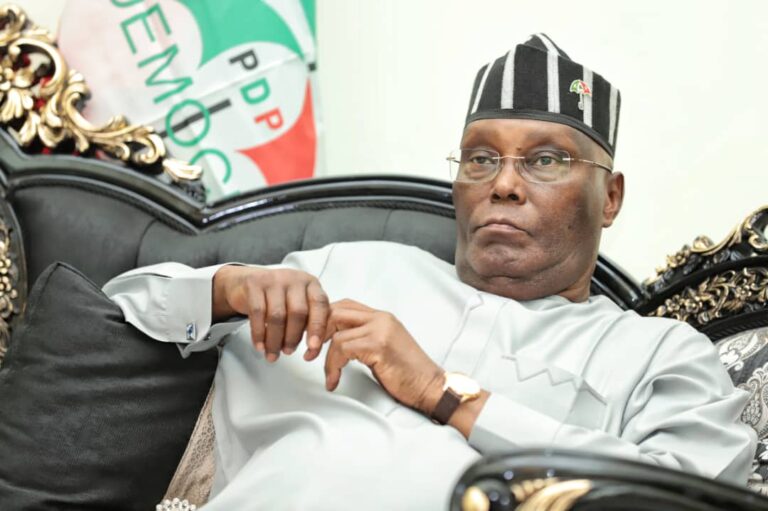
Former Vice President of Nigeria, Atiku Abubakar, yesterday announced his third resignation from the Peoples Democratic Party (PDP), and as usual, set off a wave of political reactions – this time around its significance or lack thereof, ahead of the 2027 general elections.
Atiku, who served as Vice President from 1999 to 2007, confirmed his exit in a resignation letter dated July 14, 2025, addressed to the PDP Ward Chairman in Jada 1 Ward, Jada Local Government Area of Adamawa State. The letter was released to the public on July 16 by his media adviser, Paul Ibe.
In the letter, Atiku wrote, “I am writing to formally resign my membership from the People’s Democratic Party (PDP) with immediate effect. I would like to take this opportunity to express my profound gratitude for the opportunities I have been given by the party.”
He further stated, “Serving two full terms as Vice President of Nigeria and being a Presidential candidate twice has been one of the most significant chapters of my life. As a founding father of this esteemed party, it is indeed heartbreaking for me to make this decision. However, I find it necessary to part ways due to the current trajectory the party has taken, which I believe diverges from the foundational principles we stood for.”
The announcement was met with swift condemnation from Festus Keyamo, Minister of Aviation and Aerospace Development, who questioned both the timing and style of Atiku’s resignation, particularly as it coincided with the nation’s mourning of former President Muhammadu Buhari.
“Your Excellency, whilst I acknowledge that it is within your constitutional right to change political parties at any time, releasing your resignation letter during the week of mourning for President Muhammadu Buhari is, to put it mildly, self-centred,” Keyamo posted on X (formerly Twitter).
He added, “In fact, as the record shows, you prepared, typed, signed, and delivered that letter the morning after the passing of the former President was announced. With the greatest respect to you, this clearly demonstrates that your obsession with your perennial presidential ambition knows no bounds—neither of sympathy nor empathy.”
Keyamo also criticized Atiku’s use of the national Coat of Arms in the resignation letter, calling it both “morally and legally wrong.” He cited Section 6 of the Flag and Coat of Arms Act, Cap. F30, Laws of the Federation of Nigeria, 2004, which prohibits private individuals from using national symbols to imply official authority.
“Morally, it is reprehensible to use a symbol suggesting you are acting on behalf of the authority it represents,” Keyamo said. “It borders on impersonation. Imagine if every former government functionary continued to use the Coat of Arms in their personal or political communications — there would be utter confusion.”
He concluded, “I have a bounden duty, both as a cabinet minister and a member of the Inner Bar, to protect our laws and Constitution. Please, be well guided.”
The remarks drew an immediate and equally scathing response from Umar Sani, a former PDP campaign spokesman and former media adviser to ex-Vice President Namadi Sambo. Sani accused Keyamo of politicizing a personal decision and displaying a “shocking lack of legal and factual grounding.”
“To respond so strongly to a resignation letter whose context and timing you clearly do not fully understand is, with due respect, more political than the letter itself,” Sani said in a public statement. “Atiku was not even in the country when the news of Buhari’s death broke. He had to detour to attend the funeral. There is no evidence that he personally released the letter or submitted it in person.”
Addressing the Coat of Arms controversy, Sani dismissed Keyamo’s interpretation as “alarmist and baseless.” He stated, “The Coat of Arms and national flag are not personal emblems of any officeholder. Their usage by former leaders, especially in correspondence that relates to public service or political transitions, does not constitute impersonation or illegality.”
He went further: “Atiku remains a statesman on Nigeria’s permanent protocol list. He carries a diplomatic passport, enjoys the privileges of a former Vice President, and has every moral standing to reference national symbols in formal communication.”
Sani also fired back at Keyamo’s priorities as a government minister, saying, “With your background as a lawyer who once represented the EFCC and other agencies, Nigerians are right to ask what legacy you are building now. Your energy would be better spent improving aviation safety and infrastructure than trolling political opponents.”
Reacting from the Southwest, Oyo State Governor and PDP chieftain, Seyi Makinde, struck a calm but confident tone, assuring the public that Atiku’s departure would not affect the PDP’s stability or future.
“I don’t think that will make any dent on PDP as a party,” Makinde told reporters in Akure during a colloquium marking the 10th coronation anniversary of the Deji of Akure. “PDP is an institution. People come and go. We have structures. We will move on.”
Asked about the ADC, the new coalition platform reportedly adopted by Atiku, Peter Obi, and other top political figures, Makinde said, “I do not see the ADC as a threat. It’s just another party seeking relevance. Nigerians will choose substance over novelty in 2027.”
He added, “What matters is delivering real governance, not chasing alliances or media attention. Our party will continue to present credible candidates with real solutions to Nigeria’s problems.”
Atiku’s resignation is widely believed to be tied to his 2027 presidential ambition. Alongside other opposition heavyweights like Peter Obi, Rotimi Amaechi, and Nasir El-Rufai, he is spearheading a coalition to challenge President Bola Tinubu. The group recently adopted the African Democratic Congress (ADC) as their unified platform.
As a major part of the realignment, former Senate President David Mark was appointed interim national chairman of the ADC, with former Osun State Governor Rauf Aregbesola serving as interim national secretary. Both have since left their previous parties.
Atiku’s resignation marks the third time he has exited the PDP. In 2006, he left to contest the presidency under the Action Congress of Nigeria (ACN) after falling out with then President Olusegun Obasanjo. He lost that race and returned to the PDP ahead of the 2011 election.
In 2014, he left again to join the coalition that formed the APC, losing the party’s presidential ticket to Muhammadu Buhari. Atiku returned to the PDP in 2017, securing the party’s ticket in 2019 and 2023, but lost both elections.
His political journey has been marked by consistent ambition and tactical party switches. However, his recent fallout with influential PDP figures, particularly FCT Minister Nyesom Wike, severely weakened his grip on the party.
Former PDP Deputy National Chairman, Chief Olabode George, also weighed in, describing Atiku’s exit as the “confirmation of his selfishness.” In an interview, George said, “He is more concerned about what he stands to gain than what Nigerians stand to benefit. My advice to him, as a friend and elder, is to go home and rest.”
He continued, “He was taught a lesson by Bola (President Tinubu). Now there’s nowhere else for him to go. He cannot return to the PDP, because our constitution does not permit such inconsistency anymore.”
Discover more from Keeping Them Honest
Subscribe to get the latest posts sent to your email.