

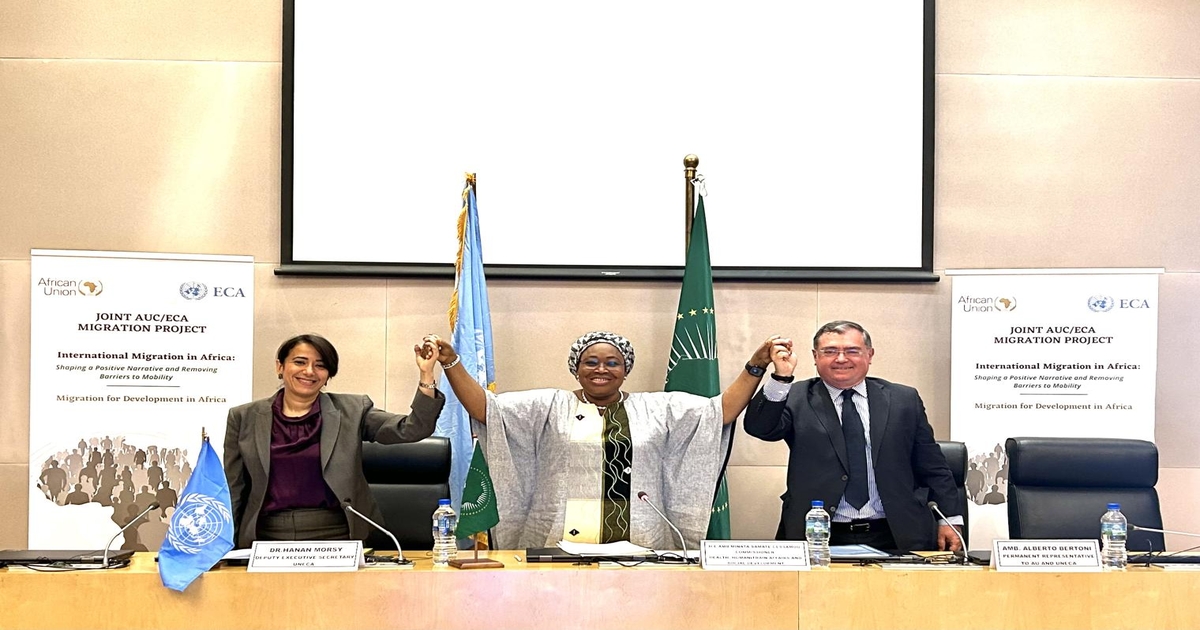
The Economic Commission for Africa (ECA), in collaboration with the African Union Commission (AUC) and other regional bodies, has launched a renewed initiative to end the legal invisibility of migrants across the continent.
Chief of ECA’s Social Policy Section, Dr. Christian Oldiges, made this known in a statement published on the ECA’s website yesterday.
According to Oldiges, hundreds of millions of people in Africa lack legal documentation, leaving migrants particularly vulnerable.
He explained that without proof of identity, individuals were excluded from education, healthcare, employment, and justice systems, rendering them invisible to the state and vulnerable to exploitation.
Oldiges spoke at a five-day regional workshop being held in Harare, Zimbabwe.
He noted that delegates from ten African countries were participating in the workshop, alongside representatives from the International Organisation for Migration (IOM) and the Intergovernmental Authority on Development (IGAD).
“Various UN agencies are also involved, as participants review new findings that underscore the scale of the challenge in addressing legal invisibility among migrants.
“The workshop, which began on Monday, introduces a newly developed ‘Good Legal Identity Toolkit’.
“It is designed to help African nations build more inclusive and accountable civil registration and ID systems,” he said.
Oldiges emphasised that legal identity was a gateway to all other rights and a cornerstone of inclusive development.
“Legal ID is not just a governance requirement, it is a human right.
“The absence of legal identity is increasingly recognised not just as a statistical gap, but as a form of poverty and exclusion.
“Recent ECA studies in Uganda, Ethiopia, and South Sudan revealed that large segments of migrant populations are unable to obtain legal identity documents due to administrative and legal barriers.
“These gaps not only expose individuals to exploitation but also heighten the risk of statelessness,” he stated.
Dr. Gideon Rutaremwa, speaking on behalf of William Muhwava, Chief of ECA’s Demographic and Social Statistics Section, stressed the need for a life-cycle approach to legal identification, from birth to death.
“To unlock Africa’s potential, we must ensure that every individual can prove their existence, identity, and family ties, beginning with birth registration,” he said.
Peter Mudungwe, Migration Governance Expert at the AUC, also highlighted the importance of harmonised efforts across borders.
He emphasised that aligning national civil registration initiatives with continental legal frameworks was essential to safeguarding the rights of migrants and stateless persons.
Similarly, IOM Chief of Mission in Zimbabwe, Diana Cartier, noted that without legal identity, migrants, especially women and children, remained vulnerable to systemic exclusion and lifelong invisibility.
“The workshop’s agenda includes policy dialogues and sharing best practices from countries such as Kenya, Uganda, South Sudan, Rwanda, Zimbabwe, and Somalia.
“Discussions aim to foster national commitments to improve inclusion, data privacy, and the legal protection of mobile populations.
“With fewer than five years remaining to achieve Sustainable Development Goal (SDG) 16.9, providing legal identity for all, the organisers underscored the urgency of action.” (NAN)
Discover more from Keeping Them Honest
Subscribe to get the latest posts sent to your email.