

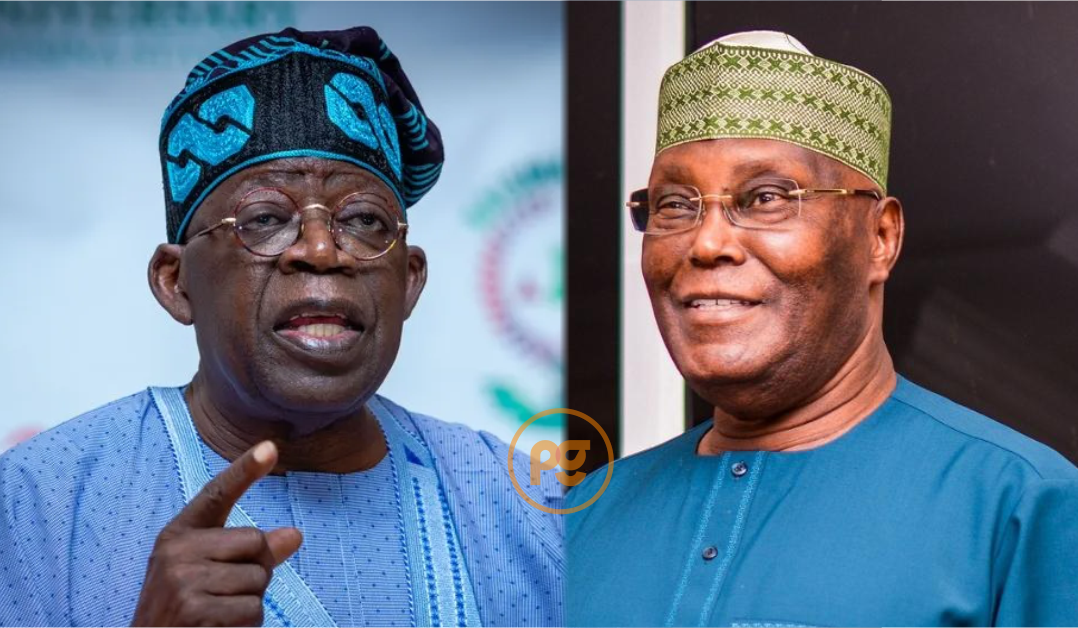
• Fani-Kayode says ex-VP crossed line of presidential decorum; Atiku camp insists title doesn’t matter as 2027 rhetoric heats up
By Abu Adamu
A fierce new front in Nigeria’s 2027 presidential battle seems to have opened after former Vice President Atiku Abubakar repeatedly stripped away the President’s official title and referred to him simply as “Bola” in his October 1 national address.
The choice has triggered accusations from the Tinubu camp that Atiku deliberately crossed a longstanding boundary of political and presidential decorum, turning legitimate criticism of an incumbent into an apparent attempt to diminish the office he himself is campaigning to occupy.
Former Aviation Minister Femi Fani-Kayode led the charge in a blistering intervention titled “And Now You Call Him Bola!”, accusing Atiku of displaying unnecessary disrespect towards the sitting President.
Atiku’s Media Adviser, Paul Ibe, has fired back, arguing that “his name is Bola” and insisting that Nigerians are more interested in food prices, petrol, electricity, jobs and insecurity than the form in which the President is addressed.
But beneath the increasingly personal exchange lies a larger question: Does political opposition excuse dispensing with the traditional courtesies attached to the office of President?
Established presidential and diplomatic etiquette suggests otherwise.
In mature presidential democracies, political opponents routinely attack an incumbent’s policies, competence and record without ordinarily dispensing with the title of the office in formal addresses.
In the United States, for example, conventional protocol provides for a sitting President to be formally addressed as “Mr President,” “the President” or “President” followed by the surname. A politician repeatedly referring to the President merely by his first name in a formal national political address would represent a conspicuous departure from that convention.
Presidential traditions have historically maintained the significant distinction because presidential titles are generally understood as courtesies attached to the office, rather than personal honours bestowed on its occupant.
That is essentially the argument advanced by Fani-Kayode.
He described Atiku’s October 1 address as calm and well-delivered but said the former Vice President undermined himself by repeatedly referring to President Tinubu simply as “Bola.”
“Surely this level of pettiness is below even you,” Fani-Kayode wrote.
His intervention followed similar concerns raised last week by Akin Osuntokun, a former Political Adviser to President Olusegun Obasanjo and Director-General of Peter Obi’s 2023 Presidential Campaign Organisation.
Osuntokun, who cannot reasonably be described as a Tinubu partisan, had argued that Atiku was perfectly entitled to criticise the President as sharply as he wished but that repeatedly calling him “Bola” was unnecessary and disrespectful.
“This is not a demand for deference to Tinubu’s policies or person. It is a demand for decorum and decency,” he said.
Osuntokun posed a simple test: imagine a former Vice President delivering a formal national address and repeatedly referring to a sitting President simply as “Segun” or “Muhammadu.”
“The rudeness would be unmistakable,” he argued.
His intervention gives the controversy a dimension beyond the predictable APC-ADC divide. Osuntokun was a leading figure in Peter Obi’s 2023 presidential campaign and therefore comes from outside the Tinubu political camp.
Fani-Kayode went considerably further, arguing that the episode fitted what he described as a longstanding pattern in Atiku’s political conduct.
He revisited Atiku’s turbulent relationship with President Olusegun Obasanjo during their second term in office and recalled the bitter political confrontation between the two men.
He also criticised Atiku’s more recent comments about former President Goodluck Jonathan and Vice President Kashim Shettima, arguing that a politician seeking the presidency should demonstrate respect for the institutions and individuals occupying the country’s highest offices even while disagreeing with them.
The former minister contended that Atiku could have delivered every criticism contained in his Independence Day address without repeatedly reducing “President Bola Tinubu” to simply “Bola.”
Ibe, however, insisted otherwise, saying, “His name is Bola. And that is not Nigeria’s problem.”
He argued that Nigeria was a republic rather than a monarchy and that a President was an elected public servant, not an emperor before whom opponents were required to “genuflect.”
“‘President’ is an office, not a compulsory prefix shielding its occupant from criticism,” he said.
That argument, however, does not directly answer the distinction raised by Atiku’s critics: acknowledging the title of an elected President neither confers monarchical powers on him nor shields his policies from attack.
Opposition politicians across presidential democracies routinely employ the title “President” while subjecting incumbents to severe criticism.
Indeed, the presidency is precisely an office — the point Ibe himself makes — and conventional protocol attaches the title to whoever legitimately occupies it.
Ibe nevertheless sought to shift the debate away from etiquette towards Tinubu’s record in office.
He asked whether food had become cheaper, petrol and electricity more affordable, Nigerians safer, incomes stronger and businesses more prosperous, arguing that these would ultimately be the issues on which Nigerians cast their ballots.
“It is easier to debate ‘Bola’ versus ‘Mr President’ than to defend what Bola’s policies have done to Nigerians,” he said.
The Tinubu administration has consistently countered that argument by maintaining that the difficult reforms undertaken since 2023 were required to pull Nigeria away from an unsustainable economic path characterised by massive petrol subsidies, distorted foreign-exchange markets and severe fiscal pressures.
The government points out that the painful adjustment is increasingly yielding gains through stronger macroeconomic fundamentals, expanding access to consumer and business credit, infrastructure investment, student loans and other social interventions intended to transmit the benefits of reform to ordinary Nigerians.
KTH Daily sources insist that those competing economic claims will undoubtedly dominate the campaign.
But observers hold that the dispute over Atiku’s language raises a different question about the standards candidates themselves intend to bring to the presidency.
Said Ufuoma Enakhire, a Lagos-based political analyst, “ As a former Vice President, Atiku knows perhaps better than most Nigerians the distinction between an individual and the office he occupies. For eight years, Atiku himself enjoyed the protocols and courtesies attached to Nigeria’s second-highest constitutional office. That is why his repeated use of “Bola” has attracted attention.
“It could have happened once inadvertently. Repetition in a prepared national address makes that explanation considerably harder to sustain and leaves critics arguing that the informality was calculated rather than accidental,” he said.
Atiku’s camp says it does not matter.
Tinubu’s supporters say it does — because a man asking Nigerians to entrust him with the presidency should be capable of fiercely opposing its present occupant without diminishing the institution he hopes to inherit.
Discover more from Keeping Them Honest
Subscribe to get the latest posts sent to your email.