

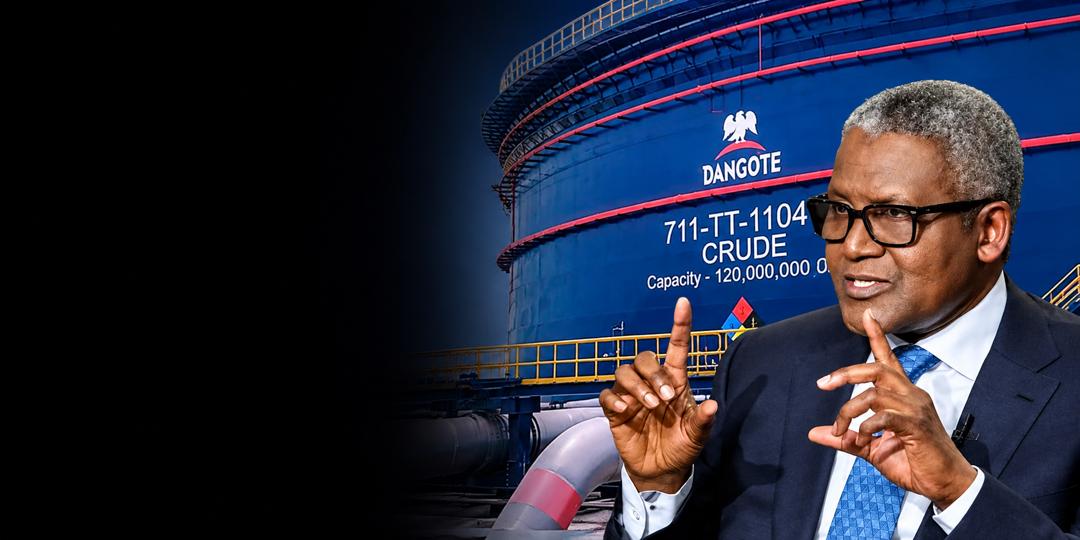
…As Atiku pushes cheaper crude for refineries, Africa’s biggest refiner says market reforms are the right path
…Opens ₦2.15tn refinery IPO, targets 1.4m barrels per day, potentially world’s largest refining complex
By Emmanuel Olugua
Africa’s leading industrialist and refinery owner, Aliko Dangote, has thrown his weight behind President Bola Tinubu’s removal of petrol subsidy and foreign exchange reforms, providing a striking counterpoint to opposition proposals for a return to government-supported pricing in Nigeria’s downstream petroleum industry.
Dangote’s position is particularly significant because it comes from the owner of the 650,000-barrel-per-day Dangote Petroleum Refinery, Africa’s largest refinery, which is targeting an expansion to 1.4 million barrels per day—a scale that could place the Lekki complex among the biggest refining facilities in the world.
Speaking on Monday at the Nigerian Exchange Limited in Lagos during the formal opening of the refinery’s ₦2.15 trillion Initial Public Offering (IPO), Dangote described the Tinubu administration’s removal of petrol subsidy and reform of the foreign exchange market as bold decisions necessary to reposition the Nigerian economy.
“I want to thank him for taking a lot of bold steps by removing the subsidy and democratising the exchange rate,” Dangote said.
The endorsement comes against a continuing political debate over the future of fuel pricing, with former Vice President Atiku Abubakar advocating a different model that would involve supporting domestic refineries with crude oil supplied on preferential terms to bring down production costs and ultimately reduce prices at the pump.
The contrast is striking: while Atiku has argued for targeted intervention at the production end of the petroleum value chain, Dangote—the man whose company operates the country’s biggest refinery and would ostensibly be among the largest potential beneficiaries of cheaper crude—has instead publicly backed the deregulation reforms undertaken by the Tinubu administration.
Dangote said his group would continue to partner with the Federal Government in its efforts to strengthen the economy.
“So, we thank you very much for your leadership and we will continue to partner with the government to ensure that we make this country great and we make Africa great,” he said.
His comments could further intensify the emerging policy argument ahead of the 2027 presidential election over whether Nigeria should consolidate deregulation or reintroduce some form of subsidy through government intervention in refinery input costs.
The Tinubu administration abolished the decades-old petrol subsidy regime in 2023, arguing that it had become fiscally unsustainable, distorted the downstream market, and consumed resources that could otherwise be deployed to infrastructure and social services.
Atiku and his African Democratic Congress have, however, proposed a different approach. Rather than returning wholesale to the old petrol import subsidy arrangement, the opposition has canvassed a targeted production subsidy under which domestic refiners could receive crude at below-market prices, subject to controls intended to ensure that the benefit is transmitted to consumers.
Dangote’s intervention therefore puts one of Africa’s biggest industrial voices firmly on the side of market-oriented reform at a time when the appropriate role of government in determining fuel prices is becoming a major political dividing line.
The billionaire businessman spoke as Dangote Petroleum Refinery and Petrochemicals formally opened its IPO on the NGX, offering 4.1 billion new ordinary shares at ₦525 each to raise approximately ₦2.15 trillion.
The minimum subscription is 10 shares, worth ₦5,250, while the offer is scheduled to close on October 13, subject to the provisions of the prospectus.
Dangote said the IPO was designed primarily to democratise ownership of the refinery rather than merely raise capital, giving ordinary Nigerians and investors around the world an opportunity to participate in the wealth generated by the massive industrial complex.
“What initially belongs to a country, begins in a deeper sense, now belongs to the people. Today is such a moment; today is a historic day,” he said.
“An asset of this magnitude should not create value for only a very few people. It should create value for millions of people, not only Nigerians, but all over the world.”
Dangote disclosed that the group had initially planned to raise $2.5 billion, comprising $1 billion through private placement and $1.5 billion from the public offer.
Demand for the private placement, however, reached about $2.5 billion against the $1 billion being sought, forcing the company to return about $1.2 billion to investors after allocations.
“We already met all our demands with the private placement. Coming back now to the IPO is actually about making sure that the public can get part of these benefits,” he said.
Dangote said he would increasingly prefer to be judged by the number of people for whom his businesses create wealth and opportunities rather than by his ranking as Africa’s richest man.
He urged Nigerians to see the IPO as an opportunity to become part-owners of an industrial business with substantial growth prospects.
“You are buying a future. It is a company that is not only about revenue, but profitability,” he said.
The refinery currently has a nameplate capacity of 650,000 barrels per day and supplies petroleum products to Nigeria as well as international markets.
Its planned expansion to about 1.4 million barrels per day would more than double existing capacity and could transform the Lekki facility into the world’s largest refining complex by capacity, if completed as proposed.
Dangote said the refinery was already making significant inroads into export markets, including Europe, where it supplies aviation fuel. According to him, its jet fuel production for August and September had already been sold out.
The company is also expanding its petrochemical operations, with plans to produce polypropylene, polyethylene, and polystyrene, creating additional industrial value chains around the refinery.
Dangote said the group was considering further expansion outside Nigeria, including a proposed refinery in Lamu, Kenya, as part of a wider strategy to demonstrate Africa’s capacity to build businesses capable of attracting global capital.
“Africa is like a scratch card. Unless you scratch it, you don’t see the use of it. The opportunities are immense,” he said.
“What we are trying to do is to open up the market and make sure that when we open up the market, Africans and non-Africans will join us to have what you call the new Africa rising.”
Chairman of NGX Group, Dr Umar Kwairanga, described the refinery IPO as a demonstration of the capacity of Nigeria’s capital market to support businesses operating at global scale.
“Transactions of this scale strengthen our proposition and demonstrate what our markets can achieve when capital, enterprise, and ambition come together,” he said.
Access Holdings Chairman, Aigboje Aig-Imoukhuede, also pointed to strong early demand for the shares, saying billions of naira had been subscribed by thousands of investors shortly after the offer opened.
For the Tinubu administration, however, perhaps the most politically significant message from Monday’s ceremony was not the size of the IPO but the policy endorsement from the businessman sitting at the centre of Nigeria’s refining revolution.
At a time when the opposition is proposing cheaper crude and targeted subsidies for domestic refiners, the owner of the country’s dominant refinery—and potentially the world’s largest if its 1.4 million-barrel expansion materialises—is making a different argument: Nigeria should stay the course on deregulation and allow market reforms to drive the next phase of its petroleum industry.
Discover more from Keeping Them Honest
Subscribe to get the latest posts sent to your email.