

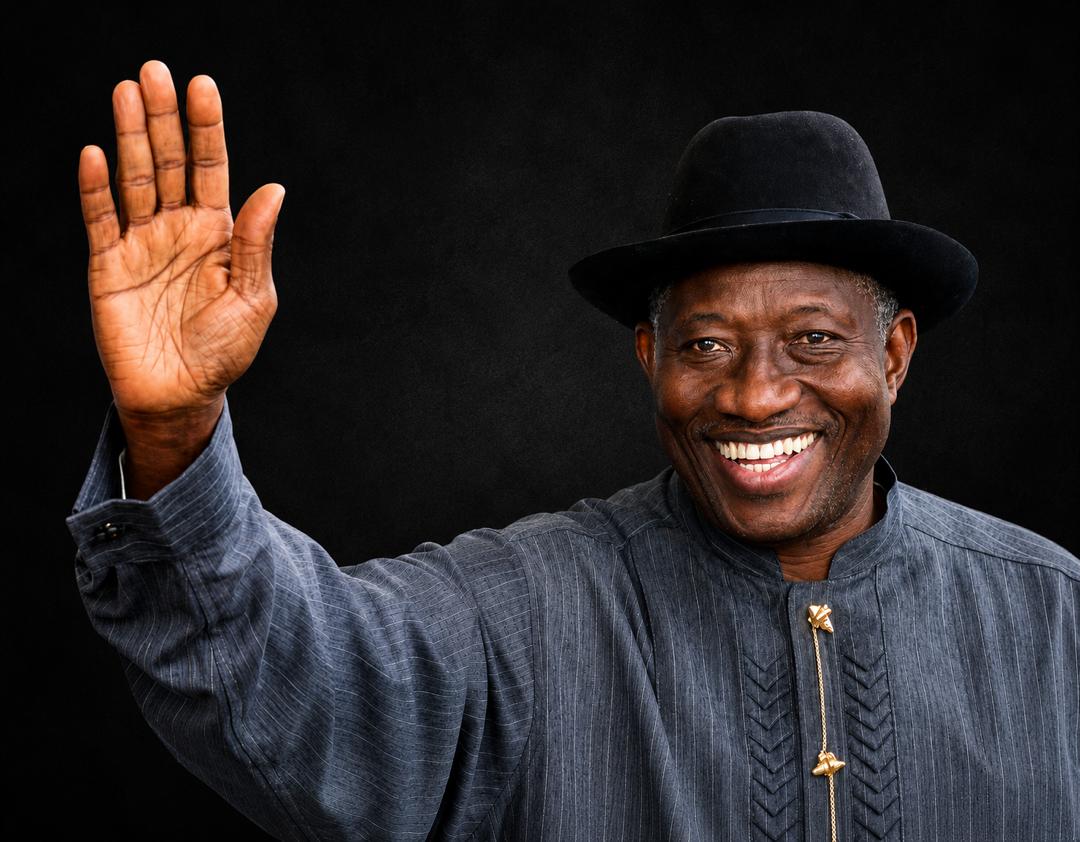
By Franklin Adole
Former President Goodluck Jonathan has warned that Nigeria and the rest of Africa risk worsening unemployment, insecurity, and social instability unless governments urgently harness the continent’s huge youth population and natural resources to drive industrialisation.
Jonathan said Africa’s abundant mineral resources and rapidly growing population would not automatically translate into prosperity, arguing that the continent’s future depended on its ability to convert raw materials into finished products, create productive jobs, and build competitive industries.
The former President spoke on Monday in Abuja while delivering a lecture to graduating Course 34 participants of the National Defence College (NDC), titled, “Harnessing Industrial Capacity for Inclusive Growth and Regional Stability in Africa.”
He said history had demonstrated that enduring economic prosperity and geopolitical influence depended not merely on the size of a country’s population or its natural endowments, but on its capacity to industrialise, innovate, and increase productivity.
According to Jonathan, Africa accounts for nearly 19 per cent of the global population, possesses enormous natural resources, and has the world’s youngest labour force, yet remains the least industrialised region.
“Rather than transforming the vast natural wealth into finished products, much of the continent continues to export raw materials while importing finished goods,” he said.
He warned that the pattern reduces domestic value addition, restricts technological advancement, and weakens industrial competitiveness while denying millions of young Africans employment opportunities.
Jonathan said the consequences had moved beyond economics and were increasingly becoming a national and regional security threat.
With more than 60 per cent of Africa’s population below the age of 25 and millions of young people entering the labour market, he said weak industrial growth meant economies were unable to create jobs fast enough to keep pace with demographic expansion.
“This resulting unemployment and economic exclusion creates a fertile ground for violent extremism, organised crime, piracy, irregular migration, communal conflicts and unconstitutional changes in government,” he warned.
The former President said Nigeria faced an especially significant demographic challenge, citing projections that the country could become the world’s third most populous nation by 2050.
He argued that the population surge could either become an enormous economic advantage or a major developmental burden, depending on whether Nigeria equipped its young people with appropriate skills and created a sufficiently vibrant industrial base to absorb them.
Jonathan, however, said there were reasons for optimism, pointing to emerging policy foundations capable of accelerating Africa’s industrial transformation.
He identified the African Continental Free Trade Area (AfCFTA) as one of the most important initiatives, saying effective and sustained implementation could substantially increase African exports by 2035 and encourage regional value chains.
He also acknowledged efforts to diversify Nigeria’s economy away from dependence on crude oil and minerals towards agro-processing, manufacturing and other productive sectors.
“Though manufacturing remains a minor and modest share of the Gross Domestic Product, recent policy reforms, private sector investments and gradual implementation of AfCFTA have created new industrial expansion opportunities in Nigeria,” Jonathan said.
He urged African leaders to stop treating industrialisation merely as one of several economic policy choices and instead recognise it as a strategic imperative for national resilience, employment creation, security and long-term economic independence.
Jonathan called for greater investment in agriculture and agro-processing, textiles and apparel, as well as digital and technology-driven industries.
“Countries with diversified industrial bases are generally better equipped to respond to economic disruptions, public health emergencies, natural disasters and geopolitical crises without excessive dependence on external support,” he said.
He cautioned Nigeria and other African countries against excessive dependence on imported food, medicines, fuel, industrial inputs and critical technologies, warning that such dependence left countries vulnerable to global supply disruptions, price shocks and external pressure.
Addressing the military and security leaders at the college, Jonathan said industrial capacity was also becoming increasingly important to national defence as modern warfare and security depended heavily on countries’ ability to develop and produce critical equipment, technologies and systems.
“Strengthening defence-related industries not only enhances operational readiness but also encourages technical innovation, skills development and provides very important greater strategic autonomy,” he said.
Jonathan also identified access to affordable finance as a major constraint to industrial development and proposed dedicated industrial funds that would provide manufacturers with long-term financing at single-digit interest rates.
He said manufacturers could not be expected to compete effectively while depending primarily on expensive commercial bank loans.
The former President equally called for aggressive investment in human capital, particularly through modern technical and vocational education and greater emphasis on Science, Technology, Engineering and Mathematics.
He cited Rwanda’s investment in public education as an example of how governments could raise standards and provide quality education at little or no cost to citizens.
Jonathan said industrialisation must also be anchored on transparency and accountability if government interventions were to produce sustainable results.
“Industrial incentives, tax concessions and public financing should be awarded through transparent, rule-based systems with defined eligibility criteria and measurable performance targets,” he said.
He recommended independent monitoring of industrial projects as well as the digitisation and regular external auditing of public procurement to reduce corruption and political interference.
Jonathan maintained that Africa already possessed the natural resources and human capital necessary to become a major global economic force, but warned that exporting raw materials while importing finished products would continue to export jobs and wealth from the continent.
For Nigeria, he said, the challenge was particularly urgent: a rapidly expanding youth population must be equipped with skills and connected to productive industries if it is to become an engine of economic growth rather than a source of deepening unemployment and instability.
Discover more from Keeping Them Honest
Subscribe to get the latest posts sent to your email.