

…Nigerians recall role of key ADC actors in Onnoghen debacle as Obi sues for sanctity of national institutions
…Atiku brands Lifu judgment ‘judicial rascality’
By Franklin Adole
A fresh political and judicial storm erupted on Monday after Justice Peter Lifu of the Federal High Court, Abuja, ordered the deregistration of the African Democratic Congress (ADC), Accord Party, Action Alliance and Zenith Labour Party, a decision that has ignited accusations of judicial overreach, renewed concerns about the independence of Nigeria’s institutions, and revived memories of the controversial removal of former Chief Justice of Nigeria (CJN), Walter Onnoghen, in 2019.
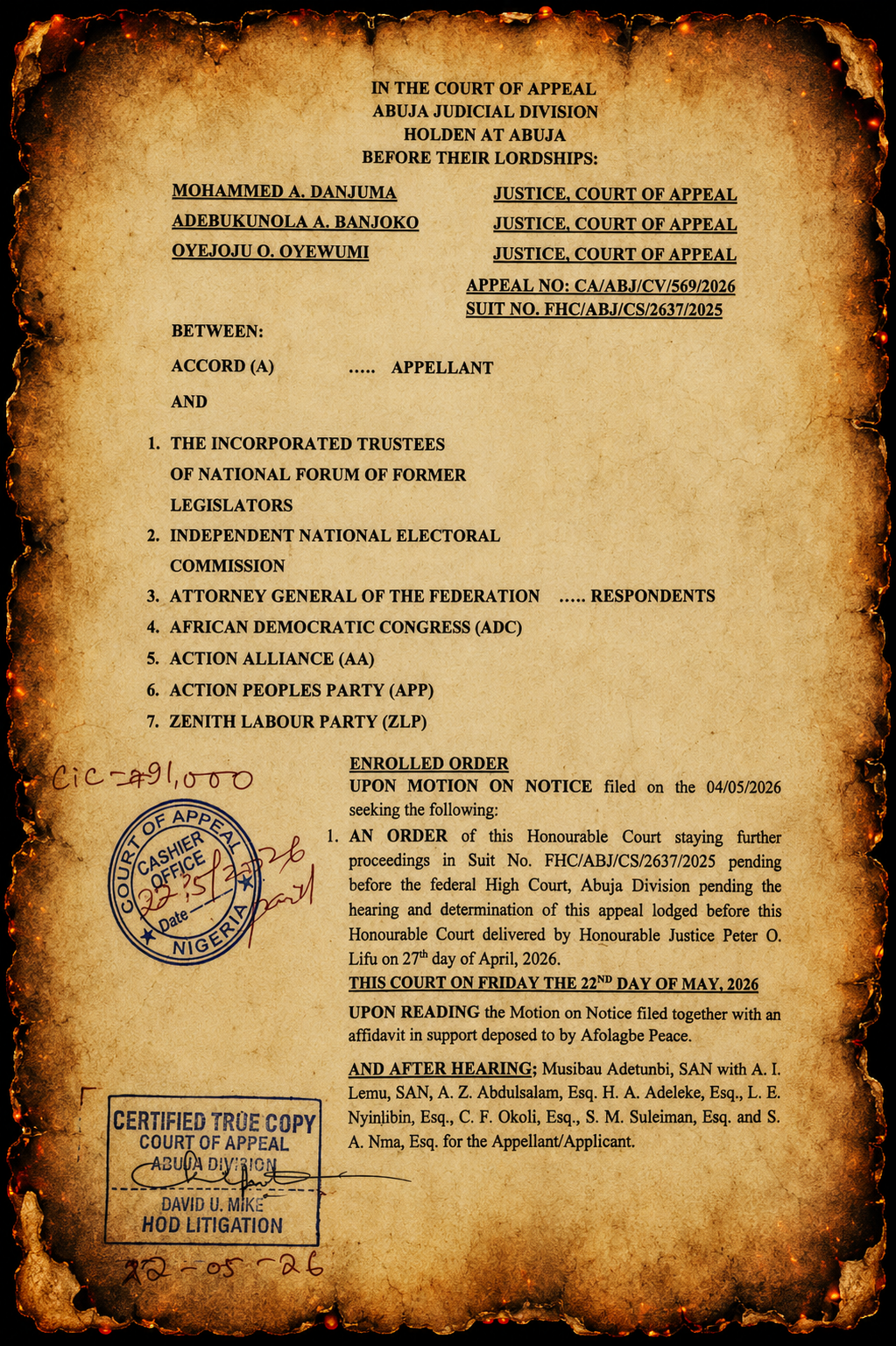
The controversy deepened because the judgment was delivered despite a subsisting order of the Court of Appeal directing the trial court to suspend proceedings pending the determination of an interlocutory appeal. A three-member appellate panel comprising Justices Mohammed Danjuma, Adebukola Banjoko and Oyejoju Oyewumi had, on May 22, ordered Justice Lifu to stay further action in the matter until issues raised in an appeal filed by the Accord Party were resolved.
The appeal arose from an application by Osun State Governor Ademola Adeleke, who sought to join the suit on the grounds that he had adopted the Accord Party as the platform for his re-election bid in the August 15 governorship election. Although Justice Lifu dismissed Adeleke’s application, the governor challenged the ruling at the Court of Appeal, which subsequently directed that proceedings be halted pending the hearing of the appeal fixed for October 27.
In a dramatic twist, however, Justice Lifu proceeded to deliver judgment on Monday, ordering the Independent National Electoral Commission (INEC) to deregister the ADC, Accord Party, Action Alliance, Action People’s Party, Zenith Labour Party, and other affected political parties.
The decision immediately drew outrage from opposition leaders.
Former Vice President Atiku Abubakar, now the ADC’s presidential candidate, described the judgement as an attempt to cripple opposition politics and move Nigeria towards a one-party state. Through his media adviser, Paul Ibe, Atiku characterised the ruling as “judicial rascality,” insisting that the judgement ought not to have been delivered while an appeal and a stay of proceedings remained before the appellate court.
“The so-called deregistration of the ADC and other parties by Justice Peter Lifu may yet be the biggest manifestation of a desperate attempt to undermine the opposition and entrench a de facto one-party state,” Atiku said.
ADC National Chairman, Senator David Mark, also condemned the judgement, describing it as “an arrow fired at the heart of Nigeria’s democracy.” He reminded party supporters that the Court of Appeal had already ordered a stay of proceedings and expressed confidence that superior courts would overturn the ruling.
As political reactions intensified, former Labour Party presidential candidate Peter Obi widened the debate beyond partisan politics, warning that repeated assaults on institutional independence were steadily eroding public confidence in Nigeria’s democratic framework.
In a strongly worded statement, Obi said the judgement reminded him of the events surrounding the controversial removal of former Chief Justice of Nigeria, Walter Onnoghen, in 2019. According to him, the greatest damage caused by such episodes is not always immediate political advantage but the long-term weakening of trust in national institutions.
“When the controversy surrounding the removal of former Chief Justice of Nigeria Walter Onnoghen unfolded, I expressed concern that the greatest damage might not be immediate, but the message it sends about the sanctity and independence of our institutions,” Obi said.
He argued that strong economies are built on confidence in the rule of law and warned that investors become wary when courts are perceived as vulnerable to political pressure.
“Businesses increasingly request that their contracts be governed by foreign jurisdictions because they have greater confidence in those institutions than in our own. That should concern every patriot,” he stated.
Obi described the Federal High Court judgement against the ADC and other parties as one of several developments that have weakened public trust in the justice system, insisting that the decision should be reversed.
His intervention quickly reopened public discussion about the Onnoghen saga, one of the most contentious judicial controversies in Nigeria’s recent history.
Onnoghen was suspended by former President Muhammadu Buhari on 25 January 2019, following an ex parte order obtained from the Code of Conduct Tribunal (CCT) over allegations of false asset declaration. He subsequently resigned on 4 April 2019, and was later convicted by the tribunal, which ordered his removal from office, the forfeiture of certain assets, and a 10-year ban from public office.
The process triggered widespread criticism from senior lawyers, constitutional scholars, and opposition politicians who argued that the Constitution required the recommendation of the National Judicial Council (NJC) and the approval of two-thirds of the Senate before a serving Chief Justice could be removed.
The controversy took another turn in November 2024 when the Court of Appeal discharged and acquitted Onnoghen after a settlement between the Federal Government and the former CJN. The court agreed that the CCT ought not to have exercised jurisdiction over the matter without first referring disciplinary issues concerning a judicial officer to the NJC. Onnoghen’s conviction, asset forfeitures, and disqualification were subsequently set aside.
The latest ADC controversy has also drawn attention to some of the prominent figures now associated with the troubled ADC.
Among them is former Attorney-General of the Federation, Abubakar Malami (SAN), who served as the nation’s chief law officer during the Onnoghen prosecution. At the time, Malami faced criticism from several legal groups and senior lawyers over the federal government’s handling of the case. Critics accused him of facilitating a process they considered unconstitutional, while supporters maintained that allegations of false asset declaration had to be investigated and prosecuted.
Former Kaduna State Governor Nasir el-Rufai, another leading figure in the emerging opposition alliance, was one of the most vocal public defenders of Onnoghen’s suspension. He repeatedly called on the former CJN to resign and publicly supported Buhari’s decision, arguing that the integrity of the judiciary was at stake.
Former Minister of Transportation Rotimi Amaechi, now ADC’s Vice Presidential candidate, was at the centre of several allegations by political opponents and pressure groups during the Onnoghen crisis. Some groups claimed he played a behind-the-scenes role in efforts to remove the former CJN. Amaechi consistently denied the allegations, describing them as false and politically motivated.
Although none of the allegations against Amaechi, Malami, or el-Rufai resulted in judicial findings of wrongdoing, their names became closely associated with one of the most divisive constitutional disputes of the Buhari era.
The coincidence of their current alignment within the ADC-led opposition movement and Peter Obi’s fresh invocation of the Onnoghen episode yesterday reopened a wider national conversation about institutional integrity, judicial independence, and the lessons of history.
Said Obi: “We must never sacrifice our sacred institutions on the altar of politics. Nations rise when institutions are stronger than individuals.”
Discover more from Keeping Them Honest
Subscribe to get the latest posts sent to your email.