

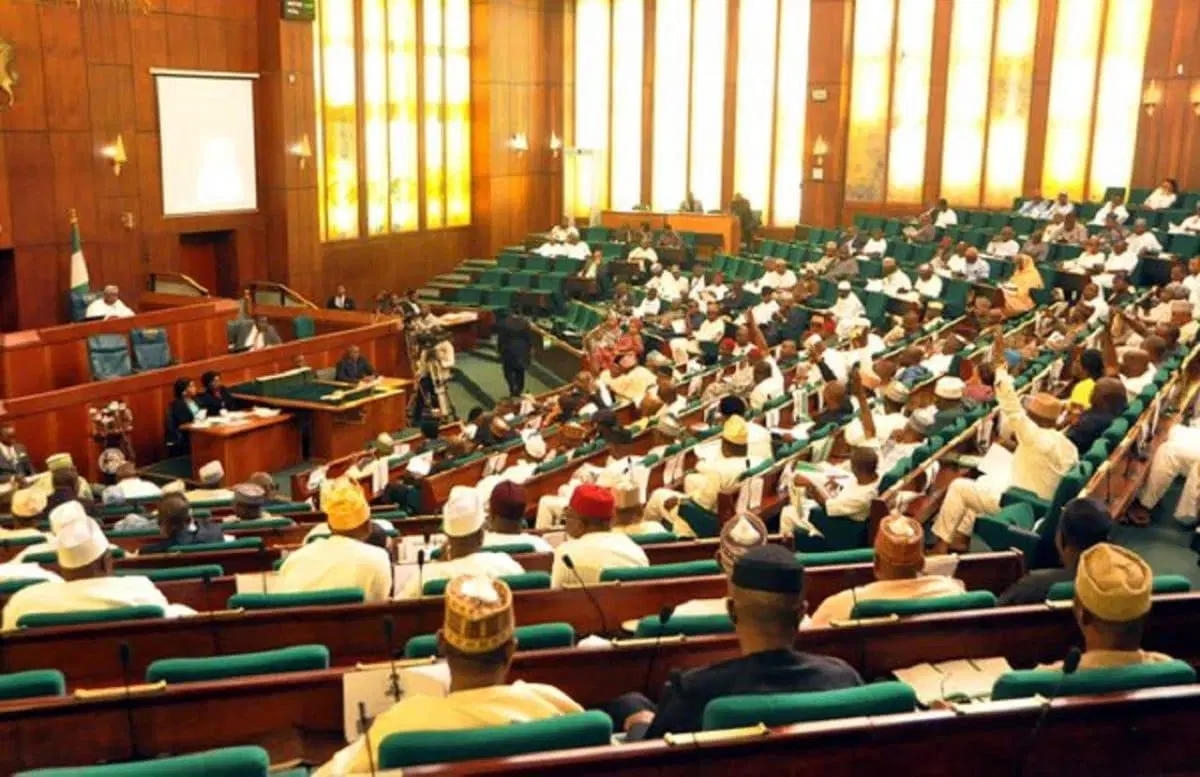
The House of Representatives has amended the Electoral Act 2026 to criminalise dual membership of political parties, prescribing a fine of ₦10 million, a maximum of two years’ imprisonment, or both for offenders.
The amendment, contained in a bill seeking to strengthen provisions on political party membership, was passed during Wednesday’s plenary after lawmakers considered it at the Committee of the Whole.
The proposed changes introduce three new subsections to Section 77 of the Act, which deals with political party membership.
Under the amendment, any individual found to be registered in more than one political party at the same time would have such memberships declared invalid.
“A person shall not be registered as a member of more than one political party at the same time,” the provision states.
It further provides that where it is established that a person holds dual membership, such memberships would be invalidated and the individual would cease to be recognised as a valid member of any political party until the situation is regularised in accordance with the Electoral Act and the constitution of the affected political party.
The bill also prescribes strict penalties for violators.
“A person who knowingly registers or maintains membership in more than one political party at the same time commits an offence and is liable on conviction to a fine of ₦10,000,000 or to imprisonment for a term of two years, or both,” the amendment provides.
During deliberations, lawmakers argued that belonging to multiple political parties undermines political integrity and creates complications during party primaries and candidate nominations.
However, Abubakar Fulata (APC–Jigawa) raised constitutional concerns, noting that denying a person membership of two parties could conflict with Section 40 of the 1999 Constitution (as amended), which guarantees freedom of association.
He suggested that the law should instead make it clear that citizens can belong to only one political party at a time rather than framing the restriction as a denial of rights.
Despite the concerns, many lawmakers strongly supported the amendment, describing dual party membership as dishonest and a form of political misrepresentation.
“You cannot put your legs in two different houses at the same time. For the sake of moral justice and honesty, you should belong to one political party at any given time,” one member said during the debate.
Lawmakers also discussed how violations would be detected, noting that the Independent National Electoral Commission (INEC) already receives party membership registers before primaries, which could help identify individuals whose names appear in more than one party’s records.
Some members expressed concern that individuals could be wrongly implicated if their names appear in multiple party registers without their consent.
In response, it was clarified that the offence would apply only where dual membership is established to have been done “knowingly,” meaning deliberate action must be proven before any penalties can be imposed.
Following the deliberations, the Committee of the Whole adopted the clauses of the bill and its long title before the House reverted to plenary to report progress.
If eventually passed by the National Assembly and signed into law, the amendment is expected to strengthen the legal framework governing political party affiliation and curb cases of multiple party memberships in Nigeria’s electoral process.
Discover more from Keeping Them Honest
Subscribe to get the latest posts sent to your email.