

By Abu Adamu
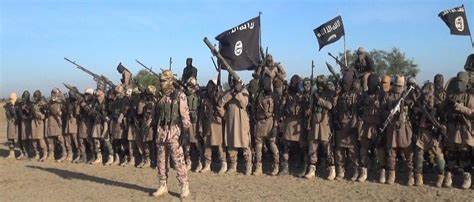
Islamic State-linked militants have launched a daring attack on Niger’s main international airport, roaming freely among passenger aircraft and setting off explosions in an operation that security analysts say reflects growing pressure on the group inside Nigeria and a widening regional spillover of the insurgency.
Reuters reports that footage distributed by SITE Intelligence Group, which monitors jihadist activity globally, showed militants moving on foot and motorcycles around aircraft at Niamey’s international airport, firing weapons into the air and detonating explosives near hangars and military assets. An unmanned aerial vehicle (UAV) and a helicopter were later seen engulfed in flames.
The attack, claimed by Islamic State’s West Africa affiliate, began late Wednesday with gunfire and loud explosions and continued into Thursday morning before calm was restored. It has triggered renewed international concern over Niger’s security, with Washington ordering the departure of non-emergency U.S. government employees and their families from the country due to rising risks.
Security analysts say the operation bears the hallmarks of Islamic State West Africa Province (ISWAP), the faction long active in Nigeria’s North-East, where sustained military pressure, backed by U.S. intelligence, surveillance and logistical support, has increasingly constrained militant movement and operations.
“The video shows IS militants speaking Kanuri, a language more commonly used in the Lake Chad basin,” said Ladd Serwat, senior Africa analyst at crisis-monitoring group ACLED. “This may indicate that more experienced drone operators from ISWAP supported the attack.”
In Nigeria, ISWAP and rival Boko Haram factions have faced intensified offensives by the Nigerian military, including targeted strikes on leadership cells, supply routes and logistics hubs. Security sources say the heightened pressure has pushed fighters to exploit porous borders, and may shift attacks into neighbouring Niger, Chad and Cameroon, where security systems are similarly stretched.
Informed observers note that the Niamey airport raid underscores that trend. Airports are high-value, symbolic targets, and analysts say the operation may have been designed to project resilience and relevance after losses inside Nigeria.
Pan-African carrier ASKY Airlines said two of its aircraft sustained minor damage while parked on the tarmac, while Ivory Coast’s national airline, Air Côte d’Ivoire, confirmed that one of its Airbus A319 aircraft was hit, damaging its fuselage and right wing. Both airlines said no passengers or crew were injured as the incident occurred outside operational hours.
Nigerien authorities said at least 20 attackers were killed, including a French national, and 11 others injured. Islamic State has not released casualty figures.
Beyond the immediate security implications, the attack has inflamed regional tensions. Niger’s military leader, Abdourahamane Tiani, accused the presidents of Benin and Ivory Coast, as well as France, of sponsoring the assault, though he provided no evidence. Benin denied the allegation, while Ivory Coast summoned the Nigerien ambassador to protest the claim.
Niger, like its Sahel neighbours Mali and Burkina Faso, has struggled for years to contain jihadist violence linked to both Islamic State and al Qaeda, with thousands killed and millions displaced across the region.
Analysts warn that unless counter-terrorism efforts are matched by deep regional coordination on intelligence, borders and joint operations, militant groups squeezed in Nigeria will continue to redirect violence into neighbouring states: turning national success into a wider regional challenge.
Discover more from Keeping Them Honest
Subscribe to get the latest posts sent to your email.