

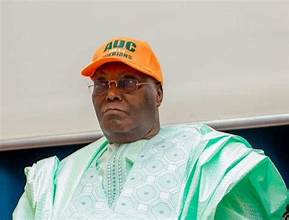
— As Peter Obi Formally Joins ADC
By Peter Salami
Nigeria’s opposition realignment ahead of the 2027 general elections gathered momentum on Tuesday as former Vice President Atiku Abubakar welcomed Peter Obi into the African Democratic Congress (ADC), describing the development as a major step toward building “a virile opposition capable of forming government” and rescuing the country from poor governance.
Atiku, in a statement reacting to Obi’s formal declaration for the ADC in Enugu, said the move marked a significant moment in the history of political coalitions in Nigeria, expressing confidence that the partnership would strengthen opposition capacity across the country.
“Today marks a significant moment in the history of political coalitions in our country, with the official declaration of my brother and associate, Peter Obi, into the African Democratic Congress,” Atiku said. “We look forward to a robust working relationship that will foster a virile opposition — one that will ultimately form a government capable of bringing prosperity and peace to our people.”
He described the ADC as a moving national coalition, saying the “ADC coalition train” had departed from Enugu, the political heart of the South-East, and expressed hope that the development would inspire other Nigerians across the regions to join the platform.
Obi, a former governor of Anambra State and presidential candidate of the Labour Party (LP) in the 2023 election, formally announced his defection to the ADC at a gathering of supporters and political leaders at the Nike Lake Hotel in Enugu, framing the decision as the beginning of a coordinated national effort to rescue Nigeria ahead of 2027.
“Today is an important day. As the last day of 2025, we are ending this year with hope that in 2026 we will begin a genuine journey to rescue our country for proper socio-economic development that will be unifying and inclusive,” Obi said.
Warning against electoral malpractice, Obi vowed that any attempt to rig the 2027 general elections would be resisted through lawful and legitimate means, accusing some beneficiaries of democracy of now aiding its erosion through intimidation and suppression of opposition voices.
“We have watched those who benefited from our democracy become accessories to destroying it through coercion and gangsterism against the opposition. We cannot allow this to continue,” he said. “Those who are planning to rig elections in 2027, we will resist it by every means lawful and legitimate.”
Obi blamed weak institutions, particularly the Independent National Electoral Commission (INEC), for recurring electoral controversies, and called for strict pre-election verification of candidates’ educational qualifications to prevent post-election disputes.
“We have one year now to verify everyone who wants to contest elections in Nigeria,” he said. “We should no longer be debating after elections whether someone went to school or not. This must be resolved before elections.”
He said his decision to join the ADC was part of a broader strategy to forge a united opposition platform capable of working with like-minded leaders across the country to reclaim Nigeria from what he described as the poor governance of the All Progressives Congress (APC).
Several prominent political figures from the South-East and other parts of the country were present at the event, including former PDP National Chairman Dr. Okwesilieze Nwodo, former Deputy Speaker of the House of Representatives Emeka Ihedioha, Senators Ben Obi, Victor Umeh, Tony Nwoye, Gilbert Nnaji, Enyinnaya Abaribe, and Sam Egwu, as well as former Imo State Governor Achike Udenwa. Other national figures aligned with the ADC coalition include former Senate President and ADC National Chairman David Mark and former Sokoto State Governor Aminu Tambuwal.
Reacting to the development, Senator Ben Obi said South-East leaders had resolved that their political future and Nigeria’s broader interest would be best served within the ADC, which he described as the most viable opposition platform ahead of 2027.
Meanwhile, the Labour Party dismissed Obi’s defection as inconsequential, describing it as a relief and declaring that the party had been “finally liberated” by his exit. In a statement signed by its National Publicity Secretary, Obiora Ifoh, the party said it had parted ways with Obi since September 2024 and accused him and Abia State Governor Alex Otti of orchestrating the party’s internal crisis.
Rather dramatically, the LP apologised to Nigerians for presenting Obi as its presidential candidate in 2023, describing the decision as a political mistake and claiming that Obi’s political influence had declined since the last election.
Discover more from Keeping Them Honest
Subscribe to get the latest posts sent to your email.