

…Plus The Many Questions He Could Not Answer
By Jeremy Fregene
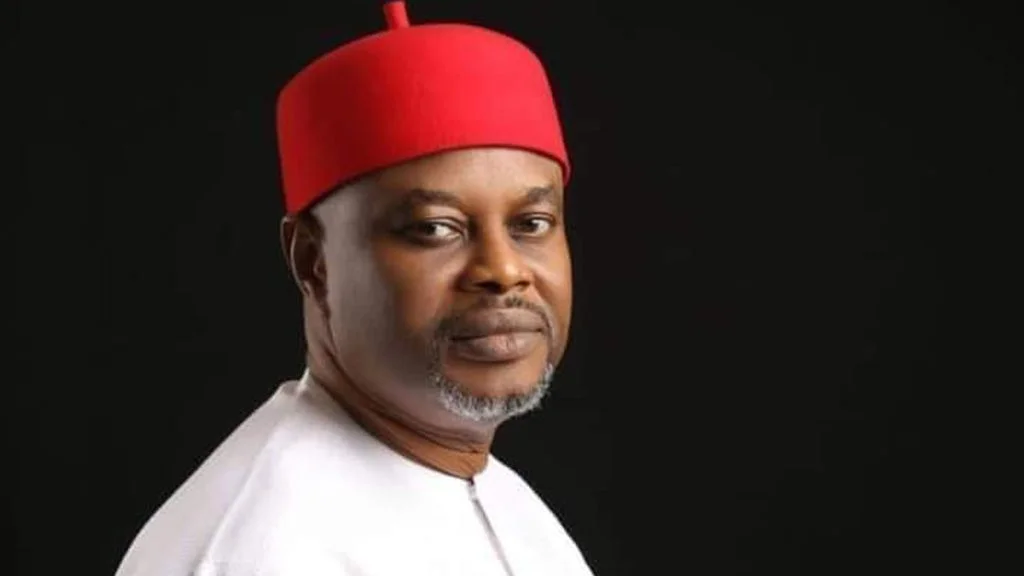
After weeks of public controversy and mounting allegations of certificate forgery, Minister of Innovation, Science and Technology, Chief Geoffrey Uche Nnaji, has resigned from President Bola Tinubu’s cabinet.
Presidential spokesperson, Bayo Onanuga, confirmed the development in a statement yesterday, saying President Tinubu had accepted the minister’s resignation “following some allegations against him.”
Onanuga recalled that Nnaji, appointed in August 2023, submitted his resignation letter thanking the President for the opportunity to serve the country. “President Tinubu thanked him for his service and wished him well in his future endeavours,” the statement added.
Nnaji’s exit comes after weeks of damaging revelations, press confrontations, and public speculation surrounding his academic credentials, which were the subject of multiple investigative reports by Premium Times. The reports alleged discrepancies in the minister’s claim to have earned a degree in Microbiology/Biochemistry from the University of Nigeria, Nsukka (UNN) and raised further doubts about his National Youth Service Corps (NYSC) discharge certificate.
In the days preceding his resignation, the minister mounted a spirited defence, accusing the Enugu State Government of orchestrating what he described as a politically motivated smear campaign. Through his Technical Assistant, Dr. Robert Ngwu, Nnaji alleged that Governor Peter Mbah and his allies were behind “a deliberate media blackmail” aimed at damaging his credibility ahead of the 2027 governorship race in Enugu State.
According to Ngwu, a December 21, 2023 letter from UNN to journalist Samuel Ogundipe of People’s Gazette had verified Nnaji’s records as a 1985 graduate. He claimed that later documents casting doubt on the authenticity of the minister’s credentials emerged only after “two card-carrying members of the Peoples Democratic Party (PDP)” assumed top positions at the university.
“This is an orchestrated plot by the Enugu State Government to ensure that Uche Nnaji does not emerge as the APC governorship candidate in 2027,” Ngwu alleged, insisting that the controversy was “a political hatchet job.”
He maintained that by academic convention, the Registrar, not the Vice-Chancellor, is the custodian of all student records, and that any subsequent intervention from the university’s top office was “political overreach.” Ngwu also claimed that despite a subsisting court order, the university had failed to release Nnaji’s transcript.
The minister’s aides further pointed to his long record of public service, including stints as Commissioner for Education, Secretary to the State Government, and Director-General of the Nigerian Governors’ Forum, as evidence of his integrity. “The DSS and other security agencies screened and cleared him before his appointment,” Ngwu said. “His reputation as a gentleman and technocrat speaks for itself.”
However, the Enugu State Government swiftly rejected Nnaji’s claims, urging him to “carry his own cross” and personally address the allegations. In a statement signed by the Director of Information in the Ministry of Information and Communication, Chukwuemeka Nebo, the state government dissociated itself from the controversy and accused the minister of attempting to deflect responsibility.
“The Honourable Minister must carry his own cross and clear his name before Nigerians, instead of dragging the Enugu State Government into issues that are entirely personal to him,” Nebo stated.
The government’s reaction followed a dramatic turn on Monday, when Nnaji failed to appear at a scheduled world press conference in Abuja. Dozens of local and international journalists had gathered at his invitation to hear his response to the allegations, but he sent aides in his place — a move that further deepened public suspicion.
According to the Enugu State Government’s statement, the proxies who appeared on Nnaji’s behalf “could not withstand the barrage of legitimate questions from journalists” and abruptly ended the event.
“Who can narrate Chief Nnaji’s UNN story better than him?” Nebo asked. “Why invite the media, only to outsource the conference? Why send third parties, who lack the answers to critical questions, if he truly has nothing to hide?”
The statement listed a series of pointed questions that Nnaji has yet to address publicly:
– Did he present a degree certificate from UNN dated July 1985 to the Senate during his ministerial screening?
– Did he later depose before a Federal High Court that he was not issued any such certificate by the university?
– If so, how did he obtain the certificate presented to the Senate?
– Is it true that he failed Virology (Course code MCB 431) in 1985 and applied to retake it in 1986?
– Why did his alleged NYSC discharge certificate bear the signature of a Director-General who did not assume office until 1988, years after his claimed period of service?
The state government also noted inconsistencies in his NYSC record, questioning how he could have begun national service in April 1985, three months before his supposed graduation, and served for 13 months instead of the statutory 12.
The questions have deepened the controversy that ultimately forced Nnaji’s resignation, with analysts suggesting that his failure to appear personally before the press and his inability to offer verifiable explanations left the presidency with little choice.
Whether Nnaji will face further investigation or political rehabilitation from the ruling All Progressives Congress, APC, remains unclear. But after weeks of sound and fury, his departure leaves behind more questions than answers: a cautionary tale about accountability in high office.
Discover more from Keeping Them Honest
Subscribe to get the latest posts sent to your email.