

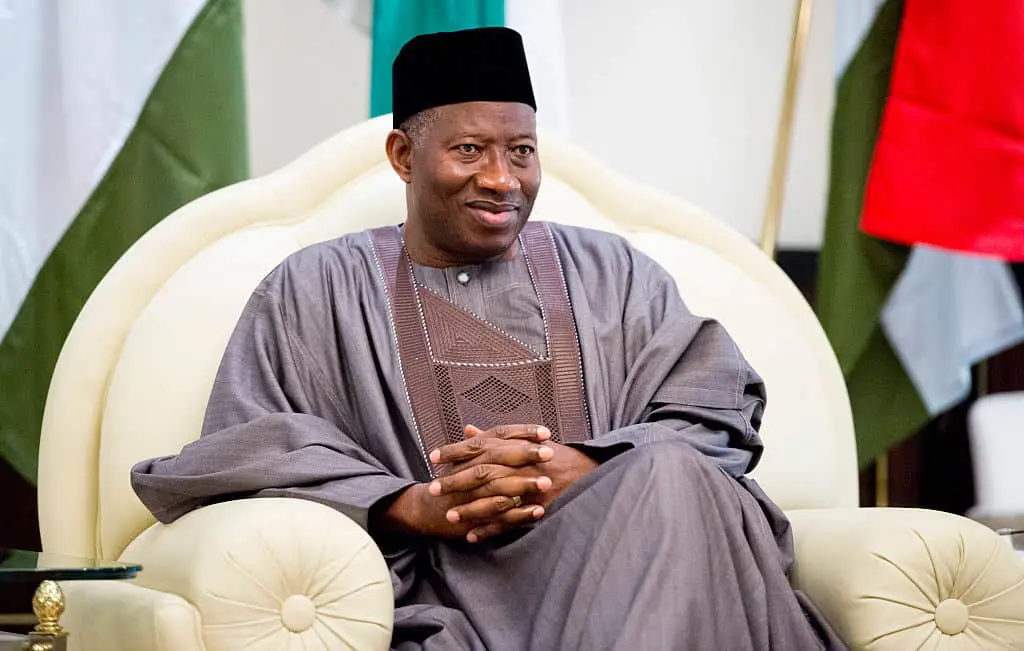
…Presidency Warns Ex-President Against Running in 2027
…Tinubu, Jonathan Records Spark Fierce Debate
By Franklin Adole
The prospect of former President Goodluck Jonathan returning to the political arena in 2027 has ignited fierce exchanges between the opposition Peoples Democratic Party (PDP) and the Presidency. The development followed a weekend remark by former Minister of Information and PDP Board of Trustees member, Professor Jerry Gana, who suggested that Jonathan would be drafted into the 2027 presidential contest. By Monday, the Presidency reacted through a lengthy statement issued by Special Adviser to the President on Media and Publicity, Bayo Onanuga, dismissing the move as absurd and warning Jonathan to be wary of what it described as “sugar-coated cheerleaders” within the PDP.
Onanuga said Jonathan was welcome to the race if he chose to run but insisted that Nigerians remember his years in power as a period of economic ruin. He argued that the former president inherited $66 billion in 2010, including $46 billion in foreign reserves and $20 billion in the Excess Crude Account, but left office in 2015 with reserves below $30 billion and the Excess Crude Account depleted to $2 billion despite record oil revenues. According to the Presidency, the Jonathan administration squandered opportunities, engaged in frivolous spending, and oversaw massive corruption in the allocation of foreign exchange and security funds, including the diversion of billions under then-National Security Adviser Sambo Dasuki. Onanuga recalled that by December 2014, the Federal Government could no longer pay salaries, while at least 28 states owed workers huge arrears. He described Jonathan’s six years as disastrous, insisting that Nigeria’s economic decline began under his watch.
In sharp contrast, Onanuga praised President Bola Tinubu for what he called bold reforms that have stabilised the economy and restored investor confidence. He pointed to the removal of the fuel subsidy, unification of exchange rates, and infrastructure renewal as decisive actions. He cited the second quarter of 2025 GDP growth of 4.23 percent, the highest in four years, as well as inflation dropping to 20.12 percent in August 2025, and reserves climbing back to $42.03 billion. He argued that Nigeria had “turned the corner” under Tinubu and that Nigerians would not allow the PDP, which he blamed for 16 years of economic mismanagement, to return to power. While acknowledging Jonathan’s constitutional right to contest, he suggested that his eligibility after being sworn in twice would ultimately be settled in court.
The Presidency’s broadside drew an immediate and pointed response from Umar Sani, former PDP presidential campaign spokesperson and former Senior Special Assistant on Media to ex-Vice President Namadi Sambo. Sani accused Onanuga of launching an unprovoked and malicious attack on Jonathan in a bid to ingratiate himself with his principal. He said the attempt to portray Jonathan as a failed leader was dishonest and amounted to a rewriting of history designed to mislead younger Nigerians who were too young to vote during Jonathan’s presidency. He declared that Jonathan was “a moving train you can’t contain,” stressing that his record of service spoke for itself.
Sani argued that Jonathan left office with tangible achievements across key sectors. He pointed out that by 2015, foreign reserves stood at $42 billion, the Sovereign Wealth Fund had $1 billion, the Excess Crude Account maintained $2.2 billion despite pressure from governors who opposed it, and the LNG signature bonus account held $5.8 billion. These, he said, were not the marks of a failed administration but of prudent economic management. He recalled that under Jonathan’s leadership, Nigeria’s economy was rebased in 2014 under the supervision of Dr. Ngozi Okonjo-Iweala, making it Africa’s largest economy and boosting investor confidence. He noted that in 2012, Nigeria was ranked among the world’s top three performing markets, while foreign direct investment surged with China and other global partners deepening their stake in Nigeria’s infrastructure and industry.
He listed achievements in power, including the completion of 14 thermal power plants under the National Integrated Power Project, adding over 5,500 megawatts to the national grid, as well as the near-completion of the Kudenda plant in Kaduna, designed to revive the textile industry. Jonathan, he said, also initiated the 700 megawatt Zungeru hydropower project and expanded the Gurara project, while constructing over 3,500 kilometres of transmission lines. On education, Jonathan established 14 new federal universities, nine of them in northern states, and built 166 Almajiri schools alongside new schools for out-of-school children in the south. In transport, Sani credited him with completing the Abuja–Kaduna standard gauge railway, rehabilitating key narrow-gauge lines, and laying the foundation for the revival of the rail sector, acknowledgments even made by Buhari’s transport minister, Rotimi Amaechi.
Sani further highlighted governance reforms initiated by Jonathan, including the Integrated Payroll and Personnel Information System to fight ghost workers and the Treasury Single Account, which later became central in plugging leakages. He said Jonathan procured critical military hardware that enabled Nigeria to reclaim territories from Boko Haram at a time when banditry and separatist militias were not part of the national security landscape. He noted that Jonathan stabilised the naira, sought to remove fuel subsidies despite resistance led by Tinubu and others, and presided over a period when living conditions were far more tolerable than they have been since 2015.
He concluded that Jonathan’s legacy cannot be erased by propaganda. For him, Jonathan’s peaceful concession of defeat in 2015 remains a global democratic milestone, but it was only one of many enduring contributions. “Whether Jonathan chooses to run in 2027 or not, his record cannot be reduced to cluelessness or non-performance. The facts speak louder than propaganda, and the palpable fear of his possible re-entry into the political arena speaks volumes. Should he decide to throw his hat into the ring, the Tinubu administration will be confronted with a moving train whose momentum may prove difficult to contain,” Sani declared.
Discover more from Keeping Them Honest
Subscribe to get the latest posts sent to your email.